

Standard Operating Procedures (SOPs)
A practical guide to understanding SOPs, how to implement them, and how to make them stick – with advice from Tom Hughes, CEO of GembaDocs.
Written by Tom Hughes, CEO of GembaDocs and lean champion.
Guide Introduction
Most business leaders understand the idea of having processes documented – reducing reliance on tribal knowledge, protecting continuity when people leave, and building something that survives a staffing crunch. But those benefits are a fraction of what well-implemented SOPs actually deliver.
The fact that they are so consistently underestimated is one of the main reasons most businesses never build the living, breathing SOP culture they intended. They don’t fully understand the upside, so they don’t allocate the time and resources to make it happen. And until recently, creating and maintaining SOPs was so cumbersome that for most teams, the effort never felt worth it.
This guide works through the questions that matter most.
Table of Contents
What is a Standard Operating Procedure?
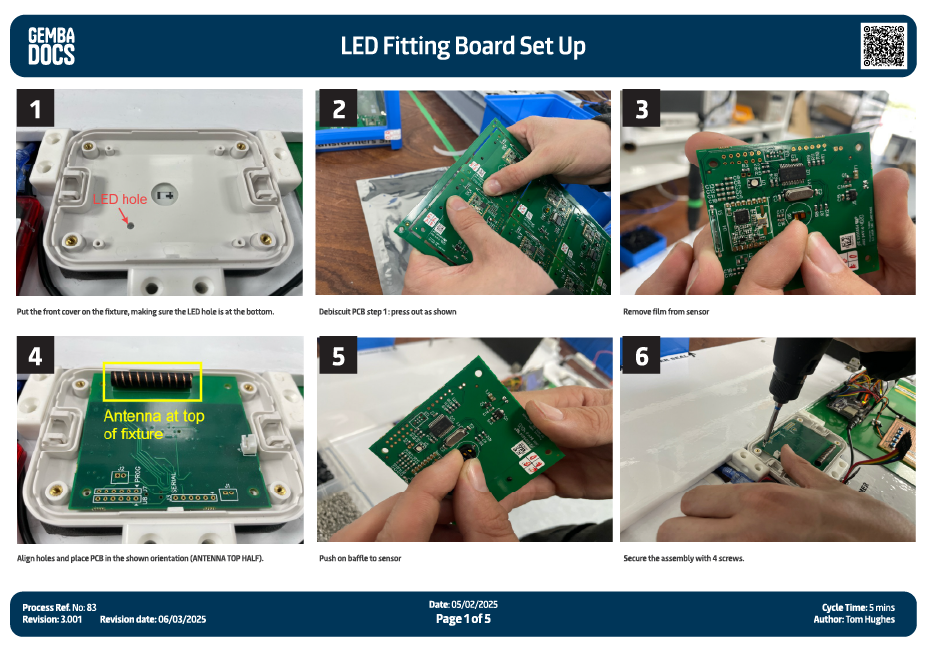
Most business leaders understand the idea of having processes documented – reducing reliance on tribal knowledge, protecting continuity when people leave, and building something that survives a staffing crunch. But those benefits are a fraction of what well-implemented SOPs actually deliver.
The fact that they are so consistently underestimated is one of the main reasons most businesses never build the living, breathing SOP culture they intended. They don’t fully understand the upside, so they don’t allocate the time and resources to make it happen. And until recently, creating and maintaining SOPs was so cumbersome that for most teams, the effort never felt worth it.
This guide works through the questions that matter most.
Why are SOPs important?
My favourite Lean quotation of all time comes from Taiichi Ohno, the ‘Father of Lean’:
“Without standards, there can be no improvement.” – Taiichi Ohno
Why would Taiichi make such a bold proclamation?
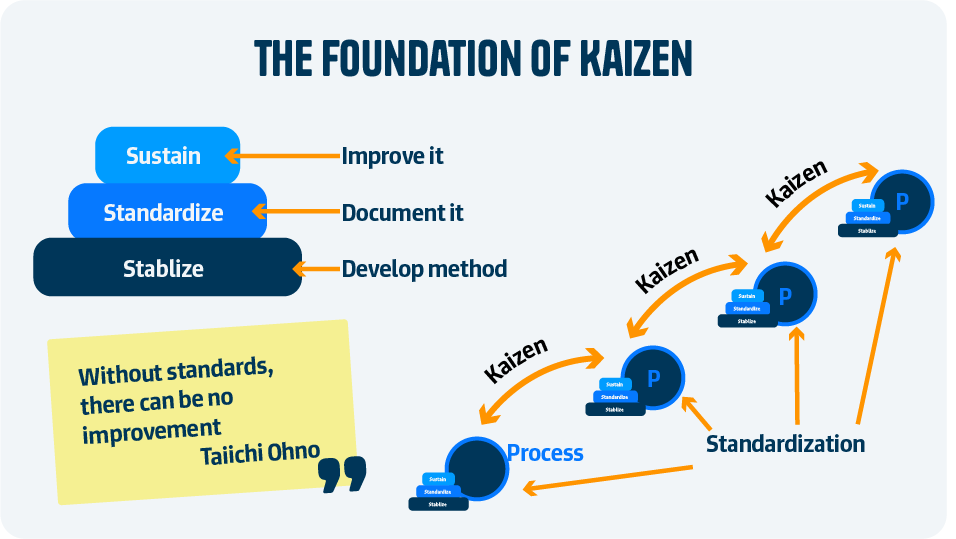
It is because of that slippery slope between the bottom of the slope shown here, which represents where most companies are: no standards (SOPs), no documented processes at all – or just as bad, what I call ‘wallpaper’ standards that nobody is using or following. Management that are divorced from the Gemba get to think that they have SOPs in place, when clearly to any objective view that they do not.
The next diagram makes it even more clear that Standards are literally the foundation of Lean.
This schematic is often used to demonstrate the Toyota Production System, represented as a ‘House Of Lean’ with Customer Satisfaction and Business Success as the apex of the roof, supported by the pillars of Just In Time, Respect for People (Culture) and Jidoka techniques. The foundation of the temple is ‘Stability and Standardization’ – with Standard Operating Procedures as one of those key principles.
It is that important.
Adding an improvement to chaos is just adding another variation that will likely stay in place for a day or two, followed by just some of the people carrying out the process, and then disappear.
Lean Guru Masaaki Imai, Founder of the Kaizen Institute, describes this better than I ever could. How often have you or your team made a great change to a process, only to come back a few days later to find that nobody is following it? That is very frustrating.
That is why having a clear process for how Standard Operating Procedures are documented is key – which is exactly what we examine in the sections below.
We created GembaDocs to reduce the burden of this Develop-Document-Improve process, making it possible to create or edit Standard Operating Procedures within minutes, not hours or days. It really is a gamechanger – making it possible to create and maintain those backstops that prevent the solid ball of your process rolling down the Quality, Cost and Customer Experience hill.
5 Benefits of Well-Implemented SOPs
When we talk about benefits here, we are talking about when SOPs are done right. That can only be achieved when the concept is well understood by all the stakeholders in the organization and the appropriate tools and resources are allocated to the SOP effort.
- A massive source of improvement. The initial ‘best of’ approach becomes the baseline for how process X is done. Making process improvements on a solid foundation means they are much more likely to stick than adding another variation to an already unstable process.
- Process improvements stick. Building on a solid foundation means improvements are far more likely to be sustained. Adding a change to an unstable process just creates another variation.
- Reduce stress for team members. There is a clear way of executing all tasks for everyone. Minimize planning hassles caused by absentees or people leaving the business. Well-implemented SOPs also ensure business continuity.
- Reduce people churn. SOPs provide a consistent basis for training. New starters get adequate support to integrate into the organization with the SOPs as their reference.
- Process stability. When team members own their already-improved process and that SOP is consistently followed by everyone, it leads to less variation in the process outcome – measurable in terms of Quality, Cost or Customer Experience. Overall less waste.
Which Processes Should Have an SOP?
We have a saying in Lean circles coming from Paul Akers: ‘everything is a process.’ I would add to that by saying that everything is a process, and if it is a process, it can be documented and it can also be improved.
So any process can be documented. Here are the two key categories:
A core value-adding process for the organization
The common example is manufacturing processes – and it is true that step-by-step SOPs originate from that sector. But that is not the end of the story. Any business-critical process, especially those that are key to adding value for a customer, should be documented. An organization does not need to have a physical product for this to apply.
Think of a dentist’s office or a hospital setting, for example. There is a process from receiving and registering a patient through to a myriad of different forms of assessment and treatment.
These kinds of processes can be both physical (a manufacturing or distribution process) or virtual and computer-based. Both benefit from having an SOP developed to improve Quality, Cost and Consistency of Customer Experience.
Simple how-to processes – turn on a machine, change a printer cartridge
‘Put the answer where the question is.’ How many times have we encountered these kinds of interruptions to the flow of our day? How do I change the paper in the printer? How do I access the wifi? How do I book in this client? And on and on. Documenting these information deficits on processes that can be significant productivity killers – and then making that answer available at point of use – is a straightforward improvement that pays back immediately.
How to Write SOPs that Your Team Will Actually Follow
We were very fortunate to have a great deal of interaction with Mark Warren on the subject of SOPs.
Mark actually wrote the manual for how Toyota delivered Standard Work training in North America, called Training Within Industry.
He was generous in helping us understand the principles better. Here is one of the posters we developed from his material – because this is an area that people get wrong so often.
The four rules for writing a job breakdown
- Rule 1: Write the job breakdown where the work is done, not at your desk
- Rule 2: Write the job breakdown as a team, not by yourself
- Rule 3: Make sure the team includes subject matter experts - the most skilled operators
- Rule 4: Test the job breakdown with your team. Practice to make sure it is not missing critical details and to define appropriate coaching units
From experience, I know this is important.
During my first ever real job back in automotive, one of my tasks was to write Standard Operating Procedures and Quality Procedures for the ISO9000 manual. It was a tremendous learning experience – I found out early on that procedures that looked great on my PC in the office, written by myself alone, were completely useless.
During those early stages, I would proudly take out my shiny new procedure that I had written with barely any consultation with the people doing the job and basically get told to move on. (See Rule 1 – I am being diplomatic in describing what they actually said.)
I learned that the whole process worked much better when I worked with the team on the workplace and Gemba to document what they were already doing, and then worked with them to agree any changes that were necessary to meet the Quality Standard. (See Rules 2, 3 and 4.) They had a much higher degree of ownership when I did things that way.
When this is done as a team, each member gets to describe how they carry out the task. Often everyone is doing it differently – and when this is surfaced, everyone gets to contribute and evaluate each other’s method. This leads to what I call the ‘best of method’: the team agrees on a compilation of each member’s best ways of doing a task, which is better than anyone’s individual approach. Not only does this create ownership within the team, but this process of creating a new baseline raises the standard of how that process is carried out for everyone.
This is a huge source of process improvement – one of the most often missed benefits of implementing SOPs. It is also a great way of building team cohesion.
In my early automotive days, I also learned another crucial lesson that few people are truly aware of.
If you are going to create an SOP, and that SOP adds burden to the people doing the job – and that burden is not 100% necessary and understood – the standard will not be followed. You will turn yourself into a police person trying to enforce the law all the time. It is key that the Standard makes getting a high-quality outcome easier, not more difficult. Easy, simple, high-quality processes get followed. Difficult, complex processes are always a struggle
How to Get Your Team to Follow SOPs
When we follow the process for writing the SOP already described, that is a big step toward ensuring that the people actually doing the job feel ownership for the SOP and are therefore likely to follow it. But on its own, this is unlikely to be enough.
It is key that everyone who carries out a given task is trained in how to do it as per the SOP. This is especially important for business-critical, value-adding processes.
This was another key part of the learning we received from Mark. We developed this graphic based on his material.
The four steps for training someone to an SOP
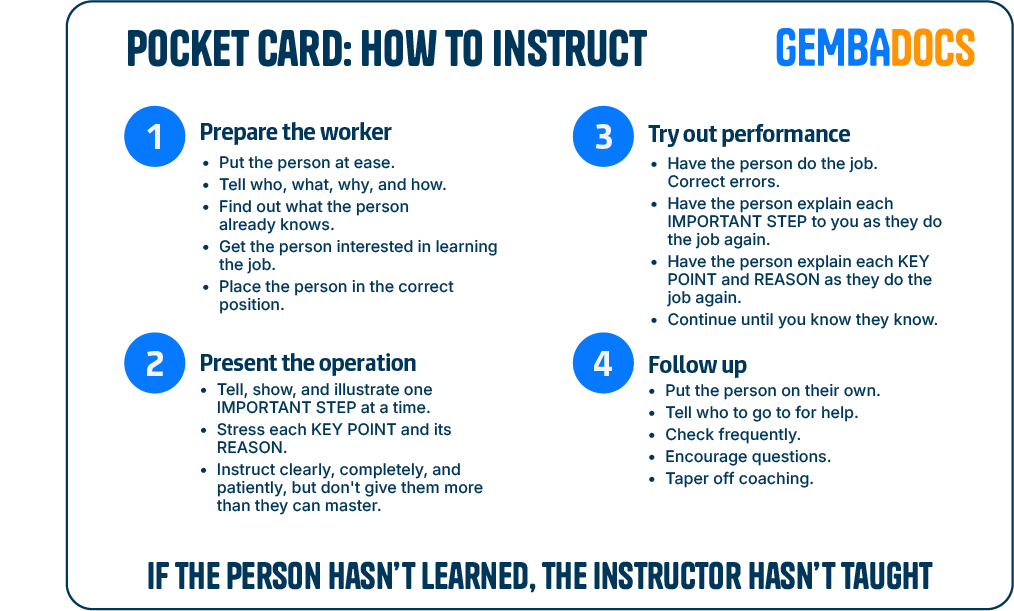
In my experience, very few organizations outside of automotive truly understand this. It is generally the exact opposite.
Preparing the worker (Step 1) and presenting the operation (Step 2) in a manner that they understand clearly – why each step is necessary and the key points to look out for – is the responsibility of the INSTRUCTOR. Trying out the new person’s performance (Step 3) so that the INSTRUCTOR is validating their understanding before they go on their own (Step 4), and then ensuring they get adequately supported before tapering off the coaching, is key.
For the vast majority of processes, if the new person does not get it, it is because the process is unclear, too complex or burdensome, or the instructor has not done Steps 1 to 3 properly. It is a true case of ‘attack the process, not the person.’
Failure in this area is a key reason why so many businesses have a problem with a ‘churn’ of new starters who do not stay long in the business, whilst creating a huge burden on the long-term team members who constantly have to support the new starts – causing further reductions in productivity because they are not actually adding value.
It is a great example where ‘pulling the andon’ and understanding what the root causes of the problem are really helps. Very often, the problems lie in these areas: poorly documented standards and training processes that stress out the new starters and the existing long-term people alike. Management needs to understand this and support a change in approach. The results can be miraculous.
Training is evidently key – but it does not just end there.
How to Keep SOPs Current
SOPs cannot be viewed as monuments – put in place once and never to be moved. A well-implemented SOP culture views SOPs as the baseline, the standard that everyone must follow. But there must also be a process in place that facilitates change and improvement.
This is most often the place that well-intentioned SOP efforts fall down.
Outdated methods – creating and editing in spreadsheets, for example – mean that adding or moving a process step turns into hours of effort. Managing a proper document control system to cope with revisions adds even more.
Often these tasks fall on one over-burdened individual who becomes the bottleneck. Eventually people just start to bypass the system. When that happens – or if the process for making changes is too cumbersome for any other reason – it will not be long before the SOPs turn into ‘wallpaper.’ They look good, but because they are now out of date, nobody is following them, and they probably provide more harm than benefit. They become a false source of security.
This particular pain-point is one of the primary reasons we developed GembaDocs. Edits can be made in seconds, approved in minutes by the appropriate people, and put live instantly – all done on the Gemba by the appropriate team. No running backward and forward to a computer for hours. Minutes.
These days we have also built in the “feedback feature” which makes the last step of the SOP a QR code inviting the viewer to provide feedback on the SOP. Is it still current? Has something changed? Did they not understand something? Prompting for feedback in this manner, closes the lopp on your system.
We do not know of a better way. It makes SOPs living, breathing and useful.
Step-by-Step SOPs or Single Video SOPs: Which Should You Use?
Some organizations try to deal with SOPs by using a single 10min long video as a method of documenting a procedure. In the first instance, this seems like the perfect answer – it can only take minutes to shoot a video on someone’s phone, right?
But then you probably need to edit it, which takes time. Then it needs to be hosted somewhere in order to be accessible to people on the Gemba – a server, the cloud, or a platform like YouTube or Vimeo.
Still manageable? Easy enough to document a process?
Up until you want to use it as a training tool for a new starter.
For a physical process, you can watch the process together first. Then you can pause it intermittently to describe it to the new person. But now you want to gradually move away as they become more autonomous. Are they expected to stop and start the video to remind themselves of process steps? Not much fun.
And what happens if you want to make a process improvement and the video needs to be revised to bring it up to date?
Video SOPs make organizations feel good – but the real test is: how many times do they get updated? If that number is low, the SOP is probably either out of date or not much is happening in the way of Process Improvement.
In our organization, some processes are on revision 10 and they have only been operating for 6 months. We make improvements and update our SOPs instantly using GembaDocs.
That is why we recommend step-by-step SOPs with photos, text or video. Step-by-step SOPs are a better training tool, and the lack of friction involved in keeping them up to date when making process improvements makes them a winning solution.
The Video to SOP tool for mobile, and desktop, in GembaDocs takes those long videos, and splices them into easy to follow steps – far better than one 10min long video with no captions or step jumps to the right section.
How to Make SOPs Accessible at the Point of Use
How team members are able to access SOPs is also important. How often have we seen work instructions, how-to’s, or manuals put into a file and then put away in a drawer just to gather dust? Hardly a way for them to be living, breathing, useful standards within an organization.
Whatever the SOP, it is key that the standard is easily accessible at Point Of Use and that all relevant team members know how to access them. The key phrase here for you to remember is “Put the answer where the question is asked.”
SOPs can be made accessible in the following ways:
- Printed out and displayed in full.
- A QR code scanned by a mobile device to display the SOP. This can also be put onto applicable process documentation and automated within an ERP system.
- Presented as a QR code or a link within the trigger for the work e.g. a Works Order or Job Card.
- A Lean Bible where SOPs can be accessed via URL links for reference.
- Via a mobile or desktop application when they have been generated with specific software - for example, GembaDocs.
The appropriate method depends on the application. Incidentally, we designed GembaDocs to have an ‘always latest’ URL – meaning that if SOPs are kept in a Lean Bible or an ERP system, the URL when clicked (or QR code when scanned) will always display the latest version without the user or administrator needing to do anything else. The right version is always in front of the right person.
Discover GembaDocs
SOP
Create, manage, and share standard operating procedures your operators will actually use. Built for the shop floor, accessible on any device.