
Six factories. Four days. Roughly a lap around Michigan.
That’s the Lean USA Tour in one sentence, but it undersells it. We walked plants building everything from utility transformer cabinets to motorcycles, and every single one of them opened their doors and let us see how they actually work, not just the version they’d show an auditor. Four days in, we came home with a long list of things worth stealing for our own operations, and a longer list of people to thank.
Here’s the trip, day by day.
Day 1: Brooks Utility
Stop one was Brooks Utility Products where they build metering boxes and transformer cabinets for utility companies. Thousands of the same product, day in and day out. About two years into their lean transformation, and it shows. Steve Jacobs led us through the plant, and a few things stopped us in our tracks.
A few things we noticed:
- A vision check system flags a wrong build with a red cross on screen. Get it right, and you get a green tick. No guessing whether the build matches the standard.
- They have overhead inspection cameras on their critical build stations, catching the work as it happens so problems get caught early, not after the fact.
- Quality alerts sit right at the point of use, with side by side OK and NOT OK photos so there’s no ambiguity about what good looks like.
- An order tracking board doesn’t just show dates. It shows the reasons behind the date changes, out in the open for anyone to see.
- Flow shelving keeps one labelled part in one lane, and cabinets ride between processes on carts instead of sitting in piles.
- A layout wall shows before and after photos, so you can watch the plant’s own progress against itself.
- They call it Daily Fix at the Source. One problem, fixed, every single day.
Day 2: Fat American Mfg
Day two of our lap around Michigan, and we landed at our hosts, Fat American Mfg, where they build metal off-road accessories for the likes of Jeep and Toyota. Just past their two year mark on lean, and one year into a new building they’ve clearly put a lot of thought into.
A few things we noticed:
- Amazing application of GembaDocs, with over 3000 SOPs, using them as packaging specifications for every SKU, bolt pack and critical process.
- They cut boxes to size on demand. No box stock sitting around waiting to be used. That single decision changes how the whole packing area works.
- Cart lanes carry direction arrows, so carts move first in, first out, without anyone needing to think about it.
- Floor markings show exactly where every cart belongs. Nothing wanders, nothing gets left in the wrong spot.
- Tools sit on balancers, screens sit at eye level, and the bench sits at working height, so the operator never has to fetch a thing.
- Every weld bay has a marked home for its cart, and every weld cell has its own dedicated fixture table.
- Even the tube cutting hazard zone is marked right on the floor, so the danger is visible before anyone gets close to it.
Day 3: TentCraft, Sherwood Mfg, and InnerSpace
Our busiest day, three stops in one lap around Michigan.
We started at TentCraft, who build promotional pop-up tents, banners, table covers, and flags with a two-day lead time. That lead time is the real story here. They started down the 2SL path nearly eight years ago and have built their own version of it since.
From there we went to Sherwood Mfg, run by brothers Ray and Al, who call their approach old-school lean, or Just in Time. And then to InnerSpace, who build medical cabinets and endoscope drying cabinets.
A few things we noticed:
- (TentCraft) A daily improvement wall carries Make it Better idea cards and kamishibai cards, right where everyone on the floor can see and use them.
- (TentCraft) Excellent application of GembaDocs with QR codes to SOPs on all their printing machines, printing out any safety critical SOPs and placing them directly on the machine itself.
- (TentCraft) Their improvement kata tracks the target, the current state, the experiments, and the obstacles. Nothing hidden, including the hard parts.
- (TentCraft) A cubby cart holds extrusions with every slot labelled, so kitting a frame is grab and go.
- Sherwood Manufacturing runs 12 robot welding cells that Ray designed and built himself! He calls them e-bots, built from eBay finds instead of a big automation vendor. We loved this!
- (Sherwood) Their fixture tables use locating blocks that position the part without anyone needing to measure it.
- (Sherwood) And the job tag on the part at Sherwood is handwritten. No system overhead. Just a clear process that works for how they work.
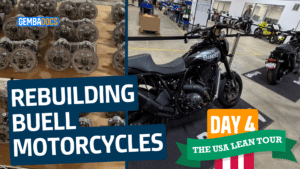
Day 4: Buell Motorcycles
Last stop, and the lap around Michigan closes at Buell Motorcycles.
Harley-Davidson shut this brand down and sold it off at auction. New ownership bought it back, and the team has built a lean factory from the ground up around an assembly line. Watching a brand come back like this, built on lean from day one, was the right way to end the tour.
A few things we noticed:
- Bikes move through the line on a lift table, past clear aisles and floor markings you can read at a glance.
- Excellent application with a terminal and GembaDocs deployed at every workstation. They use our Skills Module to track competence at every cell.
- The powertrain final assembly station has a straight, visible line of flow from stores to the line itself.
- An hour-by-hour board tracks target against actual, right where the team can see it as the shift moves.
- A skills matrix and a 5S board sit as part of daily standard work, not as posters nobody looks at.
- A PTA board keeps actions tracked on the floor, where the work actually happens.
- QA resources, alerts, and standards live right at the line, not buried in a binder somewhere.
The bigger takeaway
Six factories, six different stages of their lean journey, and not one of them looked the same.
Brooks Utility built quality checks into the build station itself.
Fat American Mfg designed out box stock entirely.
TentCraft keeps a two-day lead time by being honest about what isn’t working yet.
Sherwood Mfg built its own robots from parts off eBay.
Buell is proving you can build a lean factory from scratch, even after starting from an auction sale.
None of it came from a manual. It came from people who kept asking how to make the work easier, safer, and more visible, one day at a time.
Thank you to Steve Jacobs and the team at Brooks Utility, the team at Fat American Mfg, TentCraft, Ray and Al at Sherwood Mfg, the team at InnerSpace, and Avery and the team at Buell Motorcycles. Every one of you opened your doors to us without hesitation, and that kind of openness is rare.
And thank you to Brian Myers for organizing such a valuable Lean USA Tour.